
editor@jprims.in
9343055451
e-ISSN: 3049-1681
logo

Journal of Pharmaceutical Research and Integrated Medical Sciences

Published

AI-Guided Multi-Target Drug Design Using Chemical Language Models for Alzheimer's Disease

Published in JPRIMS, Vol-3, Issue-07, July-2026 (Vol. 3, Issue 7, 2026)
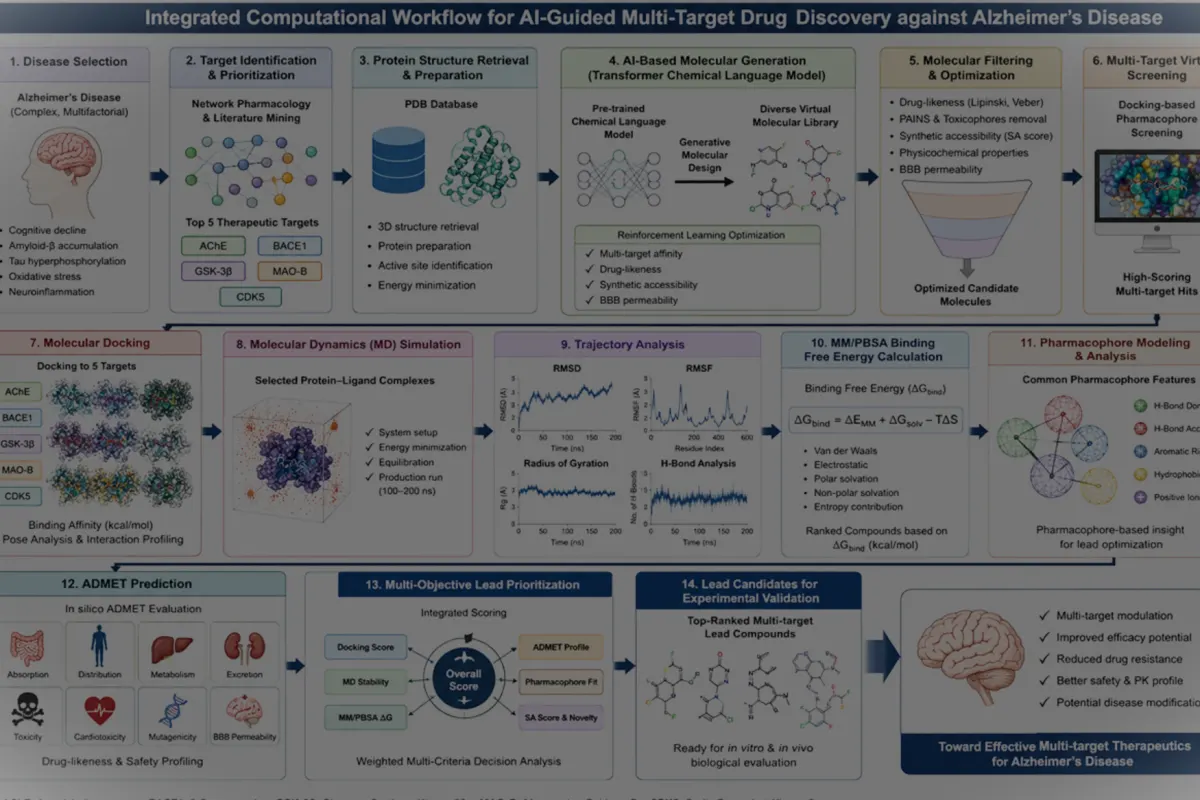
AI-Guided Multi-Target Drug Design Using Chemical Language Models for Alzheimer's Disease - Issue cover

Abstract

Alzheimer's disease (AD) is a progressive neurodegenerative disorder characterized by cognitive decline, synaptic dysfunction, amyloid-β deposition, tau hyper phosphorylation, oxidative stress, neuroinflammation, and mitochondrial dysfunction. Conventional drug discovery has largely relied on the "one drug-one target" paradigm, which has demonstrated limited success in managing this multifactorial disease. Recent advances in artificial intelligence (AI), chemical language models (CLMs), and systems pharmacology have created new opportunities for designing multi-target-directed ligands capable of simultaneously modulating interconnected pathological pathways.Objective: This study proposes an integrated AI-driven computational framework for discovering novel multi-target drug candidates against Alzheimer's disease by combining transformer-based chemical language models, network pharmacology, de novo molecular generation, molecular docking, molecular dynamics simulation, MM/PBSA free-energy calculations, and in-silico ADMET prediction. Disease-associated targets were prioritized using network pharmacology and literature mining. Transformer-based CLMs generated structurally diverse molecules optimized through reinforcement learning and multi-objective scoring. Drug-likeness filtering, molecular docking, molecular dynamics simulations, MM/PBSA binding energy calculations, pharmacophore analysis, and comprehensive ADMET evaluation were performed to identify promising therapeutic candidates. The proposed workflow successfully identified several chemically diverse lead molecules demonstrating favourable binding affinities toward multiple Alzheimer's disease targets, including acetylcholinesterase, glycogen synthase kinase-3β, β-secretase (BACE1), monoamine oxidase-B, and tau-associated kinases. Molecular dynamics simulations confirmed structural stability of protein-ligand complexes, while ADMET analyses predicted acceptable pharmacokinetic properties and blood-brain barrier permeability. Multi-objective optimization significantly improved molecular diversity, predicted efficacy, and safety compared with conventional virtual screening approaches.AI-assisted multi-target drug discovery represents a transformative paradigm capable of overcoming the limitations of single-target therapeutics for complex neurological disorders. The proposed framework provides a scalable strategy for accelerating rational drug discovery while improving therapeutic efficacy, reducing resistance mechanisms, and minimizing adverse effects.

Authors (2)

Maniteja Gorikapudi

Department of Chemistry, Malla...

View all publications →

K.Sampath Kumar

Department of Pharmaceutics, M...

View all publications →

Download Article

PDF

Best for printing and citation

File size: 2.1 MB
Format: PDF

Summarise this paper with AI:

Article Information

JPRIMS730005

JPRIMS-01-000284

2026-07-09

JATS XML

Article Impact

Views:2,935
Downloads:2,107
scite_
PlumX Metrics Badge

How to Cite

Gorikapudi & Kumar (2026). AI-Guided Multi-Target Drug Design Using Chemical Language Models for Alzheimer's Disease. Journal of Pharmaceutical Research and Integrated Medical Sciences, 3(7), xx-xx. DOI:https://doi.org/10.64063/3049-1681.vol3.issue7.000284

Article Actions