


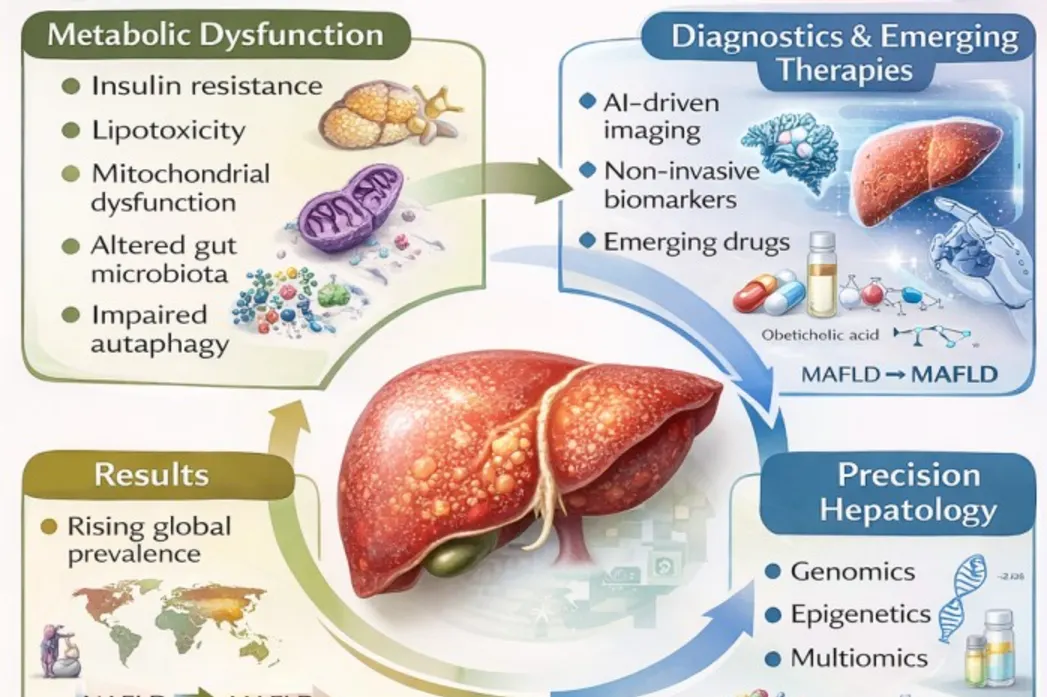
Nonalcoholic Fatty Liver Disease in the Era of MAFLD: Emerging Insights into Mechanisms, Diagnosis, and Personalized Management Global Burden and Economic Impact

Published in JPRIMS, Vol-3, Issue-07, July-2026 (Vol. 3, Issue 7, 2026)
Keywords
Abstract
References
- [1]1. Chalasani, N., Younossi, Z., Lavine, J. E., Charlton, M., Cusi, K., Rinella, M., et al. (2018). The diagnosis and management of nonalcoholic fatty liver disease: Practice guidance from the AASLD. Hepatology, 67(1), 328–357. https://doi.org/10.1002/hep.29367
- [2]2. Younossi, Z. M., Koenig, A. B., Abdelatif, D., Fazel, Y., Henry, L., & Wymer, M. (2016). Global epidemiology of nonalcoholic fatty liver disease: Meta-analytic assessment of prevalence, incidence, and outcomes. Hepatology, 64(1), 73–84. https://doi.org/10.1002/hep.28431
- [3]3. Targher, G., Byrne, C. D., & Tilg, H. (2021). NAFLD as a multisystem disease: A new paradigm in understanding fatty liver. The Lancet Diabetes & Endocrinology, 8(4), 320–331. https://doi.org/10.1016/S2213-8587(19)30349-8
- [4]4. Estes, C., Anstee, Q. M., Arias-Loste, M. T., Bantel, H., Bellentani, S., Caballeria, J., et al. (2018). Modeling NAFLD disease burden in four countries. Hepatology, 67(1), 123–133. https://doi.org/10.1002/hep.29368
- [5]5. Wong, R. J., Aguilar, M., Cheung, R., Perumpail, R. B., Harrison, S. A., Younossi, Z. M., et al. (2019). Nonalcoholic steatohepatitis is the second leading etiology of liver disease among adults awaiting liver transplantation in the United States. Gastroenterology, 156(4), 1013–1021. https://doi.org/10.1053/j.gastro.2018.12.020
- [6]6. Younossi, Z. M., Anstee, Q. M., Marietti, M., Hardy, T., Henry, L., Eslam, M., et al. (2017). Economic and clinical burden of NAFLD in the United States and Europe. Hepatology, 65(5), 1236–1245. https://doi.org/10.1002/hep.28914
- [7]7. Eslam, M., Sanyal, A. J., & George, J. (2021). A new definition for metabolic dysfunction associated fatty liver disease: An international expert consensus statement. Journal of Hepatology, 73(1), 202–209. https://doi.org/10.1016/j.jhep.2021.03.039
- [8]8. Tilg, H., Effenberger, M., & Moschen, A. R. (2021). MAFLD vs NAFLD: How is the definition changing our approach to fatty liver disease? Nature Reviews Gastroenterology & Hepatology, 18(2), 81–82. https://doi.org/10.1038/s41575-020-00381-0
- [9]9. Fouad, Y., Kamal, M., & Eslam, M. (2021). What’s in a name? Renaming “NAFLD” to “MAFLD”. Liver International, 41(1), 101–103. https://doi.org/10.1111/liv.14645
- [10]10. Riazi, K., Charlton, M. R., Sanyal, A. J., Loomba, R., Schattenberg, J. M., Rinella, M. E., et al. (2022). Global prevalence of NAFLD and NASH: Systematic review and meta-analysis. Hepatology, 76(6), 1234–1248. https://doi.org/10.1002/hep.32235
- [11]11. Cotter, T. G., & Rinella, M. (2021). NAFLD 2021: The state of the disease. Gastroenterology, 158(7), 1851–1864. https://doi.org/10.1053/j.gastro.2021.01.052
- [12]12. Vos, M. B., Abrams, S. H., Barlow, S. E., Caprio, S., Daniels, S. R., Kohli, R., et al. (2017). NASPGHAN clinical practice guideline for pediatric NAFLD. Journal of Pediatric Gastroenterology and Nutrition, 64(2), 319–334. https://doi.org/10.1097/MPG.0000000000001454
- [13]13. Kim, D., Yuan, X., Liu, Y., & Loomba, R. (2021). Age and NAFLD: Epidemiologic trends and clinical implications. Liver International, 41(1), 12–20. https://doi.org/10.1111/liv.14703
- [14]14. Yasutake, K., Yoneda, M., Han, N., Tamaki, N., Yamamoto, N., Enomoto, M., et al. (2021). Characteristics of lean NAFLD: Clinical and genetic insights. Journal of Hepatology, 72(1), 137–144. https://doi.org/10.1016/j.jhep.2019.07.030
- [15]15. Rich, N. E., Oji, S., Mufti, A. R., Browning, J. D., Parikh, N. D., Odewole, M., et al. (2018). Racial and ethnic disparities in NAFLD. Hepatology, 67(2), 512–523. https://doi.org/10.1002/hep.29569
- [16]16. Powell, E. E., Wong, V. W. S., & Rinella, M. (2021). The socioeconomic burden of NAFLD: Challenges and opportunities. The Lancet Gastroenterology & Hepatology, 6(8), 684–692. https://doi.org/10.1016/S2468-1253(21)00131-6
- [17]17. Samuel, V. T., & Shulman, G. I. (2012). Mechanisms for insulin resistance: Common threads and missing links. Cell, 148(5), 852–871. https://doi.org/10.1016/j.cell.2012.02.017
- [18]18. Begriche, K., Massart, J., Robin, M. A., Bonnet, F., & Fromenty, B. (2019). Mitochondrial dysfunction in NAFLD: A pathophysiological hallmark. Journal of Hepatology, 70(4), 665–685. https://doi.org/10.1016/j.jhep.2018.11.022
- [19]19. Lebeaupin, C., Vallée, D., Hazari, Y., Hetz, C., Chevet, E., & Bailly-Maitre, B. (2018). ER stress signaling and the pathogenesis of NAFLD. Trends in Endocrinology & Metabolism, 29(5), 349–358. https://doi.org/10.1016/j.tem.2018.02.009
- [20]20. Lin, C. W., Zhang, H., Li, M., Xiong, X., Chen, X., Chen, X., et al. (2021). Role of autophagy in NAFLD and NASH: Pathogenesis and therapeutic implications. Pharmacology & Therapeutics, 107768. https://doi.org/10.1016/j.pharmthera.2021.107768
- [21]21. Li X, Li Z, Zhang Y, et al. Evaluation of fibrosis markers and renal injury biomarkers in patients with chronic kidney disease: a cross-sectional study. BMC Nephrol. 2022;23(1):150. https://doi.org/10.1186/s12882-022-02743-6
- [22]22. Jha V, Garcia-Garcia G, Iseki K, et al. Chronic kidney disease: global dimension and perspectives. Lancet. 2013;382(9888):260–272. https://doi.org/10.1016/S0140-6736(13)60687-X
- [23]23. GBD Chronic Kidney Disease Collaboration. Global, regional, and national burden of chronic kidney disease, 1990–2017: a systematic analysis for the Global Burden of Disease Study 2017. Lancet. 2021;395(10225):709–733. https://doi.org/10.1016/S0140-6736(20)30045-3
- [24]24. Drawz PE, Rosenberg ME. Slowing progression of chronic kidney disease. Kidney Int Suppl (2011). 2013;3(4):372–376. https://doi.org/10.1038/kisup.2013.75
- [25]25. Stevens PE, Levin A. Evaluation and management of chronic kidney disease: synopsis of the kidney disease: improving global outcomes 2012 clinical practice guideline. Ann Intern Med. 2013;158(11):825–830. https://doi.org/10.7326/0003-4819-158-11-201306040-00007
- [26]26. Inker LA, Heerspink HJL, Tighiouart H, et al. GFR slope as a surrogate endpoint for kidney disease progression in clinical trials: a meta-analysis of treatment effects of randomized controlled trials. J Am Soc Nephrol. 2019;30(9):1735–1745. https://doi.org/10.1681/ASN.2019030264
- [27]27. Rysz J, Gluba-Brzózka A, Franczyk B, et al. Novel biomarkers in the diagnosis of chronic kidney disease and the prediction of its outcome. Int J Mol Sci. 2017;18(8):1702. https://doi.org/10.3390/ijms18081702
- [28]28. Lopez-Giacoman S, Madero M. Biomarkers in chronic kidney disease, from kidney function to kidney damage. World J Nephrol. 2015;4(1):57–73. https://doi.org/10.5527/wjn.v4.i1.57
- [29]29. Doi K, Ishizu T, Fujita T, et al. Use of biomarkers in assessing drug-induced kidney injury. Expert Opin Drug Metab Toxicol. 2011;7(7):803–817. https://doi.org/10.1517/17425255.2011.583939
- [30]30. Bolignano D, Donato V, Coppolino G, et al. Neutrophil gelatinase-associated lipocalin (NGAL) as a marker of kidney damage. Am J Kidney Dis. 2008;52(3):595–605. https://doi.org/10.1053/j.ajkd.2008.01.020
- [31]31. Jung K, Kashani K. Biomarkers in acute and chronic kidney diseases. Curr Opin Nephrol Hypertens. 2016;25(3):230–235. https://doi.org/10.1097/MNH.0000000000000214
- [32]32. Vanmassenhove J, Vanholder R, Nagler E, Van Biesen W. Urinary and serum biomarkers for the diagnosis of acute kidney injury: an in-depth review of the literature. Nephrol Dial Transplant. 2013;28(2):254–273. https://doi.org/10.1093/ndt/gfs380
- [33]33. Guzzi F, Cirillo L, Roperto RM, et al. NGAL and kidney injury: a new marker opens new perspectives. Kidney Blood Press Res. 2019;44(5):639–652. https://doi.org/10.1159/000501961
- [34]34. Donadio C. Serum and urinary neutrophil gelatinase–associated lipocalin in chronic kidney disease and end-stage renal disease. Clin Chim Acta. 2014;428:100–105. https://doi.org/10.1016/j.cca.2013.11.012
- [35]35. Paragas N, Qiu A, Zhang Q, et al. The Ngal reporter mouse detects the response of the kidney to injury in real time. Nat Med. 2011;17(2):216–222. https://doi.org/10.1038/nm.2290
- [36]36. Mori K, Lee HT, Rapoport D, et al. Endocytic delivery of lipocalin-siderophore-iron complex rescues the kidney from ischemia-reperfusion injury. J Clin Invest. 2005;115(3):610–621. https://doi.org/10.1172/JCI23056
- [37]37. Haase M, Bellomo R, Devarajan P, et al. Accuracy of neutrophil gelatinase-associated lipocalin (NGAL) in diagnosis and prognosis in acute kidney injury: a systematic review and meta-analysis. Am J Kidney Dis. 2009;54(6):1012–1024. https://doi.org/10.1053/j.ajkd.2009.07.020
Authors (4)
Jampala Raghu Ram
Sultan Ul Uloom College of Pha...Sultan Ul Uloom College of Pharmacy, Mount Pleasan...Sultan Ul Uloom College of Pharmacy, Mount Pleasant, Banjara Hills, Ro...Sultan Ul Uloom College of Pharmacy, Mount Pleasant, Banjara Hills, Road No: 3, Hyderabad.500034
View all publications →Obaid Alhilali
Sultan Ul Uloom College of Pha...Sultan Ul Uloom College of Pharmacy, Mount Pleasan...Sultan Ul Uloom College of Pharmacy, Mount Pleasant, Banjara Hills, Ro...Sultan Ul Uloom College of Pharmacy, Mount Pleasant, Banjara Hills, Road No: 3, Hyderabad.500034
View all publications →Mohammed Ashfaq Hussain
Sultan Ul Uloom College of Pha...Sultan Ul Uloom College of Pharmacy, Mount Pleasan...Sultan Ul Uloom College of Pharmacy, Mount Pleasant, Banjara Hills, Ro...Sultan Ul Uloom College of Pharmacy, Mount Pleasant, Banjara Hills, Road No: 3, Hyderabad.500034
View all publications →Mohammed Abdul Farhan
Sultan Ul Uloom College of Pha...Sultan Ul Uloom College of Pharmacy, Mount Pleasan...Sultan Ul Uloom College of Pharmacy, Mount Pleasant, Banjara Hills, Ro...Sultan Ul Uloom College of Pharmacy, Mount Pleasant, Banjara Hills, Road No: 3, Hyderabad.500034
View all publications →Download Article
Summarise this paper with AI:
Article Information
Article Impact
Smart Citations
scite shows how a scientific paper has been cited by providing the context of the citation, a classification describing whether it supports, mentions, or contrasts the cited claim, and a label indicating in which section the citation was made.

How to Cite
Raghu Ram, J., Alhilali, O., Ashfaq Hussain, M., & Abdul Farhan, M. (2026). Nonalcoholic Fatty Liver Disease in the Era of MAFLD: Emerging Insights into Mechanisms, Diagnosis, and Personalized Management Global Burden and Economic Impact. Journal of Pharmaceutical Research and Integrated Medical Sciences, 3(7), 33-50. https://doi.org/10.64063/3049-1681.vol3.issue7.000282
Article Actions
More from this Issue
Enhancing Oral Bioavailability of Poorly Water-Soluble Drugs: Current Developments in Nanotechnology, Lipid Systems, and Solid Dispersions
More by These Authors
Green Synthesis of Nanoparticles for Pharmaceutical Applications: Sustainable Alternatives in Drug Formulation
2025 • Vol. 2, Issue 8
Read more →Artificial Intelligence-Powered Translational Nanomedicine in Oncology: Clinical Developments, Multistage Targeting Techniques, And Prospects for Brain, Liver, Breast, and Kidney Cancers
2026 • Vol. 3, Issue 8
Read more →Design of Liposomal Drug Delivery Systems for Enhanced Cancer Therapy
2025 • Vol. 2, Issue 7
Read more →