


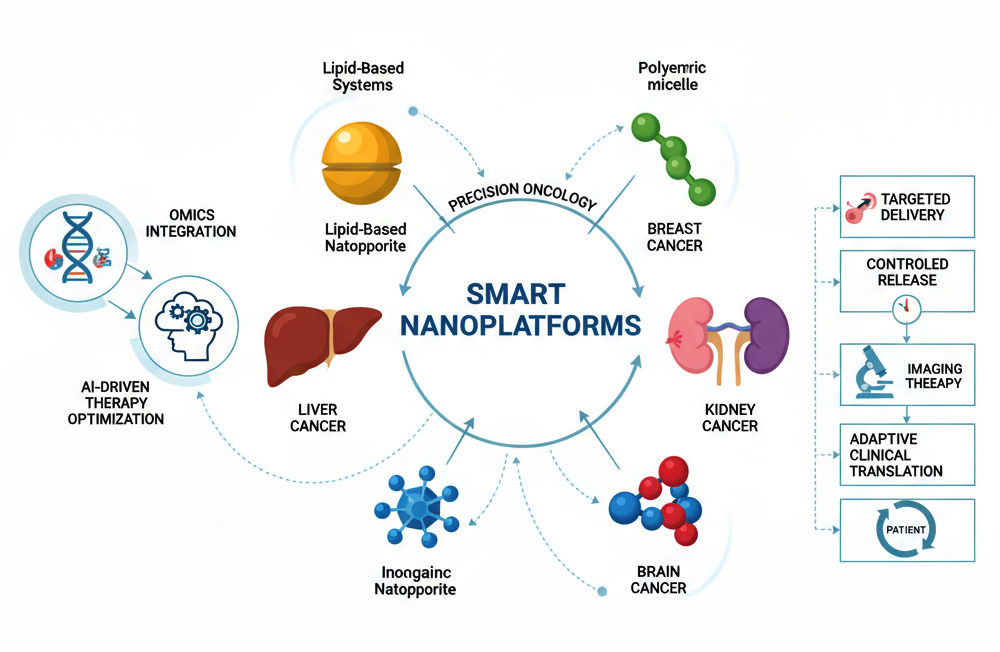
Systematic Review of Smart Nanoplatforms in Liver, Breast, Kidney, and Brain Cancers: Targeted Delivery, Omics, and Therapy Response

Published in JPRIMS, Vol-3, Issue-02, Feb.-2026 (Vol. 3, Issue 2, 2026)
Keywords
Abstract
Authors (5)
Niharika Tiwari Tiwari
Kamla Institute of Pharmaceuti...Kamla Institute of Pharmaceutical Sciences, Shri S...Kamla Institute of Pharmaceutical Sciences, Shri Shankaracharya Profes...Kamla Institute of Pharmaceutical Sciences, Shri Shankaracharya Professional University, Shri Shanka...
View all publications →Mohit Kumar Sahu Sahu
Kamla Institute of Pharmaceuti...Kamla Institute of Pharmaceutical Sciences, Shri S...Kamla Institute of Pharmaceutical Sciences, Shri Shankaracharya Profes...Kamla Institute of Pharmaceutical Sciences, Shri Shankaracharya Professional University, Shri Shanka...
View all publications →Gitanjali Kashyap Kashyap
Kamla Institute of Pharmaceuti...Kamla Institute of Pharmaceutical Sciences, Junwan...Kamla Institute of Pharmaceutical Sciences, Junwani, Bhilai, Dist.-Dur...Kamla Institute of Pharmaceutical Sciences, Junwani, Bhilai, Dist.-Durg, Chhattisgarh, India. Pin-49...
View all publications →Aakansha Pandey Pandey
Kamla Institute of Pharmaceuti...Kamla Institute of Pharmaceutical Sciences, Shri S...Kamla Institute of Pharmaceutical Sciences, Shri Shankaracharya Profes...Kamla Institute of Pharmaceutical Sciences, Shri Shankaracharya Professional University, Shri Shanka...
View all publications →Vinay Sagar Verma Verma
Kamla Institute of Pharmaceuti...Kamla Institute of Pharmaceutical Sciences, Shri S...Kamla Institute of Pharmaceutical Sciences, Shri Shankaracharya Profes...Kamla Institute of Pharmaceutical Sciences, Shri Shankaracharya Professional University, Shri Shanka...
View all publications →Download Article
Summarise this paper with AI:
Article Information
Article Impact
Smart Citations
scite shows how a scientific paper has been cited by providing the context of the citation, a classification describing whether it supports, mentions, or contrasts the cited claim, and a label indicating in which section the citation was made.

How to Cite
Tiwari Tiwari, N., Kumar Sahu Sahu, M., Kashyap Kashyap, G., Pandey Pandey, A., & Sagar Verma Verma, V. (2026). Systematic Review of Smart Nanoplatforms in Liver, Breast, Kidney, and Brain Cancers: Targeted Delivery, Omics, and Therapy Response. Journal of Pharmaceutical Research and Integrated Medical Sciences, 3(2), 1-13. https://doi.org/10.64063/3049-1681.vol.3.issue2.2
Article Actions
More from this Issue
More by These Authors
Advances in Nanotechnology for Targeted Drug Delivery in Central Nervous System
2024 • Vol. 1, Issue 1
Read more →Injectable Liposomal Formulations for Sustained Release of Anticancer Drugs
2025 • Vol. 2, Issue 9
Read more →Stability Analysis of Herbal Nasal SpraysUnder Simulated Storage Conditions
2025 • Vol. 2, Issue 5
Read more →